HP-03 / 08
PlateSight™
PlateSight™ Curb Intelligence watches every curb cut on the campus and optimizes curb dwell in real time, so every driver, vehicle, and pedestrian is exactly where the campus needs them.
Driver throughput
Throughput is the measure that matters at the curb. PlateSight™ tracks every handoff from the Drivers Only door to a waiting vehicle, and every second a vehicle spends at the curb without one.
- Peak handoffs per hour
- 1,140
- Mean curb dwell
- 41 s
- Dwell target
- 38 s
- Bay turnover
- 2.9 min
- Vehicles in holding pattern
- 186
- Mean laps per driver
- 3.1
Modeled for a Friday at 6:40 p.m., Phase I at full availability.
The holding pattern
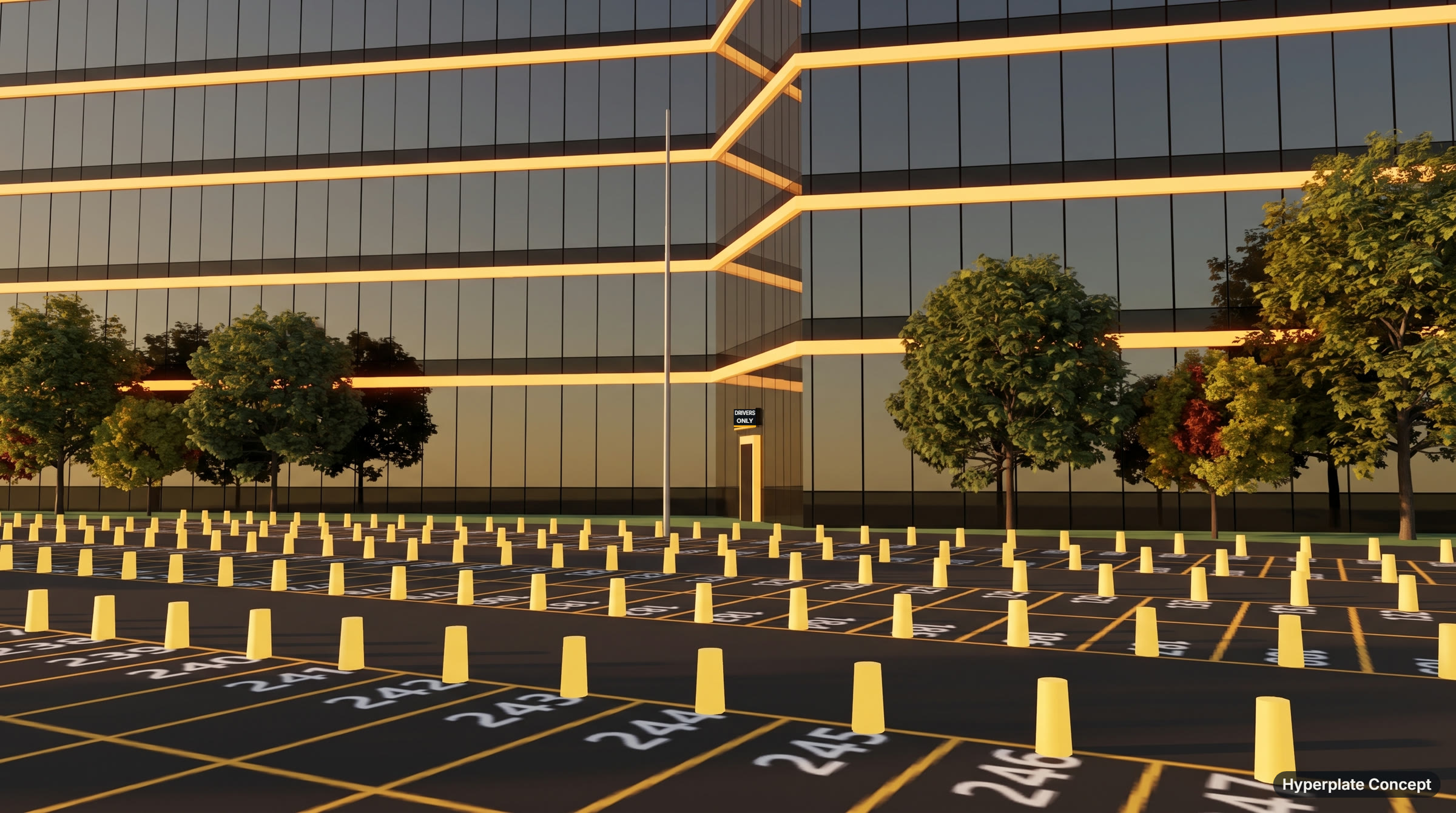
When all 400 bays are occupied, arriving drivers enter the holding pattern: a smooth, continuous loop of E. Walnut St., S. State St., E. Park St., and Summit St. The loop is about 1.2 km long and takes roughly two minutes and twenty seconds to complete.
Vehicles in the pattern never stop and never park. PlateSight™ releases each driver from the pattern the moment a bay opens, ranked by order readiness and reliability score. To a neighbor, the pattern appears as steady, unhurried traffic at all hours.
Curb states
PlateSight™ assigns every curb occupant to one of five states, updated ten times a second.
| State | Condition | Response |
|---|---|---|
| Staged | A driver in a numbered bay with an order in progress. | None required. |
| Dwelling | A driver at the curb with an order ready. | Dwell timer starts. |
| Lingering | Any vehicle at the curb for more than 38 seconds. | The pole’s halo pulses teal. |
| Pedestrian | A person on foot within a curb zone. | Observed, for their own safety. |
| Optimized | An empty curb. | None. This is the preferred state. |
Community safety
PlateSight™ poles stand at every curb cut onto the campus: four on E. Walnut St. and four on Library Road. Each pole carries four cameras and a teal halo, which glows to let neighbors know their curb is being optimized.
Every vehicle, cyclist, stroller, and dog that enters a curb zone is observed for its own safety. Observations are retained for as long as they remain useful to curb performance.
- Poles
- 8
- Cameras per pole
- 4
- Curb cuts covered
- 100%
- State updates per second
- 10